
Key takeaways
- A wind mitigation inspection records the features that help your home stand up to hurricane winds, on Florida's official form OIR-B1-1802.
- Insurers use that form to apply the wind discounts Florida law requires them to offer.
- The inspector checks 7 things, from your roof covering to how your roof is tied to your walls.
- Citizens accepts a form for up to 5 years, as long as the structure hasn't changed.
- My Safe Florida Home offers free inspections when the program is funded.
A wind mitigation inspection might be the cheapest thing you can do to lower your home insurance. It doesn't change your house at all. It just proves to your insurer what's already there. Here's what happens during one, what the inspector looks for, and how to get ready.
What is a wind mitigation inspection?
It's an inspection that fills out Florida's Uniform Mitigation Verification Inspection Form, known as OIR-B1-1802. The form documents the features that reduce wind damage. Florida Statute 627.0629 requires home insurers to offer discounts, credits or lower deductibles for those features, and this form is how your insurer knows which ones you have.
The state updated the form in 2026. The new version, Rev. 04/26, took effect April 1, 2026.
What does the inspector check?
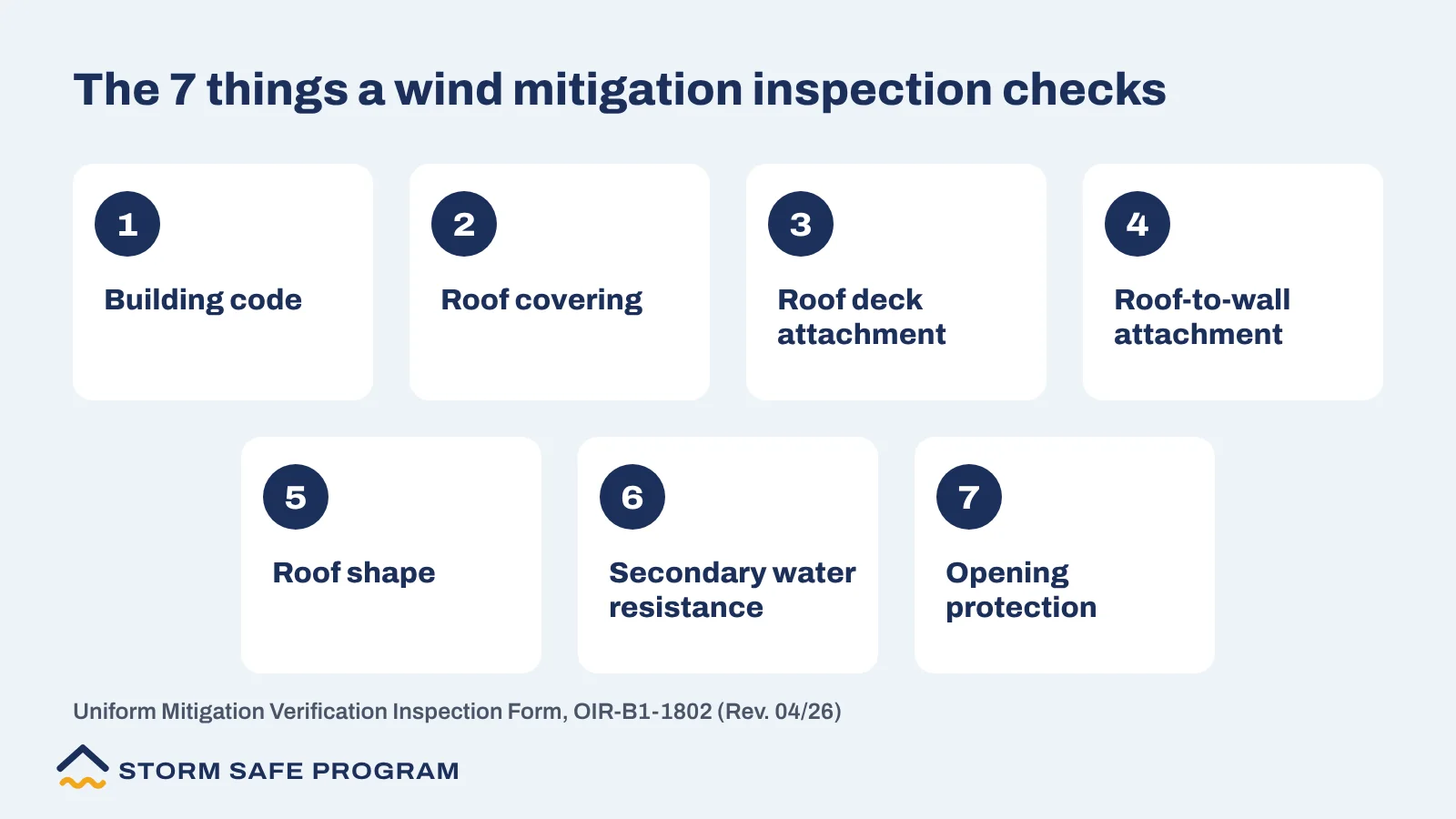
Here's each one in plain terms:
- Building code. When the home was built and which version of the Florida Building Code applied. Newer homes often have many features built in already.
- Roof covering. Whether your shingles, tile or metal meet the building code. The inspector needs a permit or product approval and the year it was installed.
- Roof deck attachment. How the roof sheathing is nailed to the frame. Bigger nails, closer together, hold better.
- Roof-to-wall attachment. How the roof frame is connected to the walls. More on this below.
- Roof shape. Hip roofs, which slope down on all four sides, earn a discount. Gable roofs don't.
- Secondary water resistance. Whether there's a sealed layer under the roof covering that keeps water out if shingles blow off.
- Opening protection. Whether your windows, doors, skylights and garage door are protected by impact rated products or approved shutters.
Why roof-to-wall connections matter so much
In a hurricane, wind tries to lift the roof straight off the house. The connection between the roof frame and the walls is what holds it down. From weakest to strongest, the form looks at toe nails, clips, single wraps and double wraps.
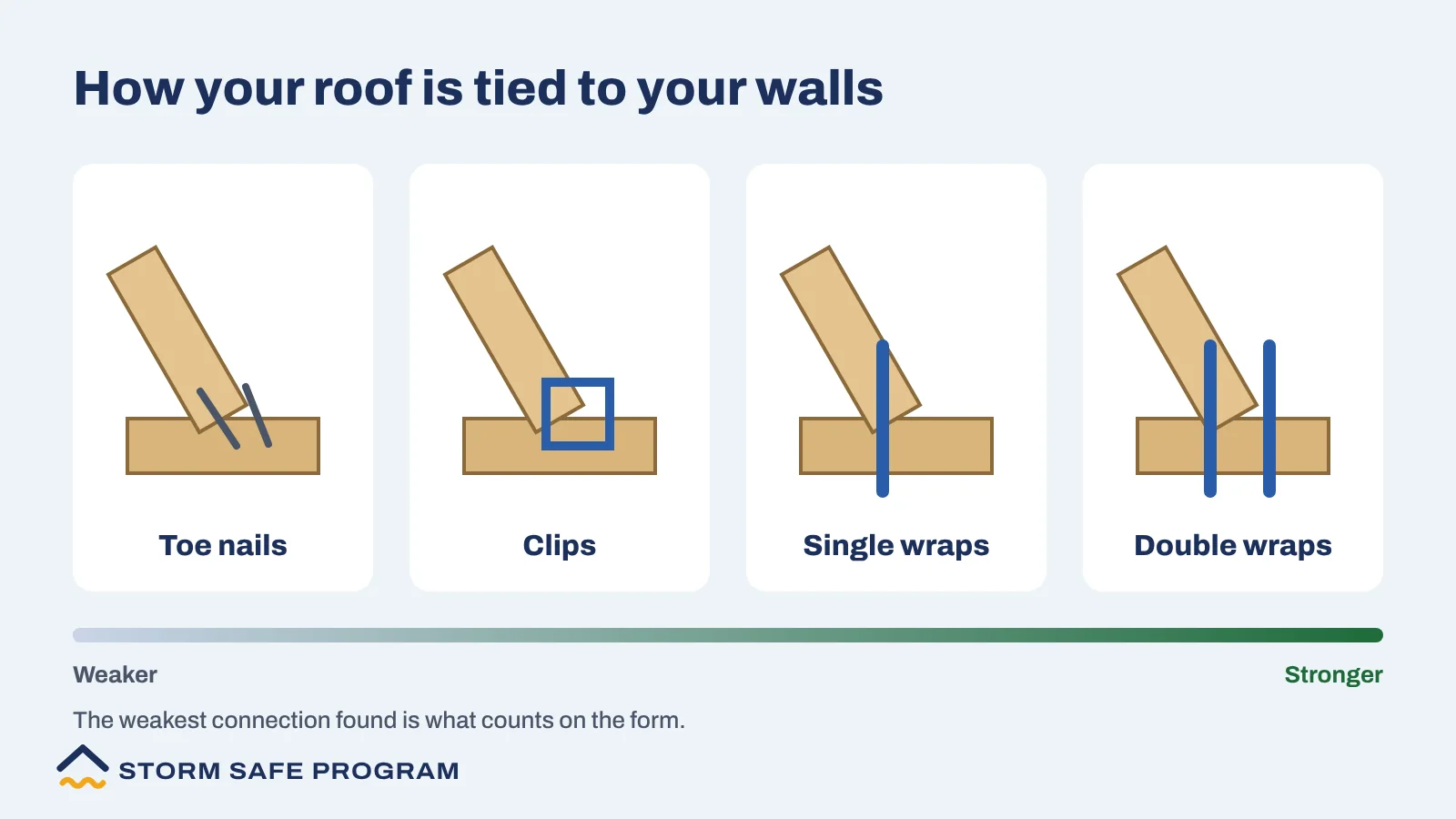
Citizens Property Insurance's guide is clear about one thing: the weakest connection the inspector finds is the one that counts. The same goes for openings. One unprotected window can keep you from getting the opening protection credit.
Who can do the inspection?
The form has to be signed by a qualified inspector, such as a home inspector, contractor or engineer, and by the homeowner. Citizens won't give mitigation credits if the form is filled out by an unqualified or unlicensed inspector, so check the inspector's license with the Florida Department of Business and Professional Regulation before you book.
How long is a wind mitigation report good for?
Citizens accepts a form for up to 5 years, as long as nothing about the structure has changed. If you get a new roof, new windows or new doors, get a new inspection so your insurer sees the upgrades.
How much does it cost?
Prices vary by inspector and home, so get a quote. There are a couple of ways to get one for free:
- My Safe Florida Home offers free wind mitigation inspections when the program is funded. Check mysafeflhome.com for the current status.
- PITCH Roofing includes a free wind mitigation inspection with select new roof packages.
How to get ready for the inspector
- Clear the way to your attic access. The inspector needs to see the roof deck and the roof-to-wall connections.
- Pull together permits, invoices or product approval numbers for your roof, windows, doors and garage door.
- Find the label on your garage door if it has one. It shows the door's wind or impact rating.
- If you have shutters, have them handy so the inspector can see the product labels.
Not sure how old your roof is? PITCH Roofing's guide on what's considered an old roof in Florida can help.
What if the report shows weak spots?
That's actually useful. It tells you exactly what to fix. If your roof is more than 10 years old, or your windows or doors aren't impact rated, and you live in Hillsborough or Pinellas County, Storm Safe Program can walk you through your options to replace them, with no upfront costs in most cases. Start with our free hurricane safety assessment. Here's how it works.
Common questions
Is a wind mitigation inspection the same as a 4-point inspection?
No. A 4-point inspection looks at the age and condition of your roof, electrical, plumbing and heating and air systems, mostly so an insurer can decide whether to cover an older home. A wind mitigation inspection documents wind resistant features so you can get discounts.
Does a hip roof really lower my insurance?
Hip roofs earn a mitigation discount on the form. How much it's worth depends on your insurer.
How long does a wind mitigation report last?
Citizens accepts a form for up to 5 years as long as the structure hasn't changed. After upgrades, get a new one.
Can I get a wind mitigation inspection for free?
My Safe Florida Home offers free inspections when it's funded, and PITCH Roofing includes one with select new roof packages.
Start with a free hurricane safety assessment
Call or text "Safety" to (727) 687-3364, or see if your home qualifies.
Sources
- Citizens Property Insurance: Uniform Mitigation Verification Inspection Form changes
- Citizens Property Insurance: Wind Loss Mitigation Guide (Rev. 04/26)
- Florida Statute 627.0629, Residential property insurance; rate filings
- My Safe Florida Home, Florida Department of Financial Services
- PITCH Roofing: Roof inspections
- PITCH Roofing: What is considered an old roof?