
Key takeaways
- Florida Statute 627.0629 requires home insurers to offer discounts, credits, other rate differentials or lower deductibles for features that reduce wind damage.
- The law names features like roof strength, roof covering performance, roof-to-wall strength and opening protection.
- You usually prove those features with a wind mitigation inspection on Florida's official form, OIR-B1-1802.
- Each insurer sets its own amounts. The law requires the discount, but it doesn't set a number.
- A separate law, 627.7011, limits when an insurer can refuse you just because of your roof's age.
If you own a home in Florida, you've probably heard someone say "get a wind mit and your insurance goes down." That's mostly true, and there's a real law behind it. Here's what Florida Statute 627.0629 says, what it doesn't say, and how to get the credit on your own policy.
What does Florida Statute 627.0629 say?
The statute says insurers' rate filings for residential property "must include actuarially reasonable discounts, credits, or other rate differentials, or appropriate reductions in deductibles" for homes with features that help prevent wind damage.
In plain English: if your home has features that make it hold up better in a hurricane, your insurer has to price that in.
Which features count?
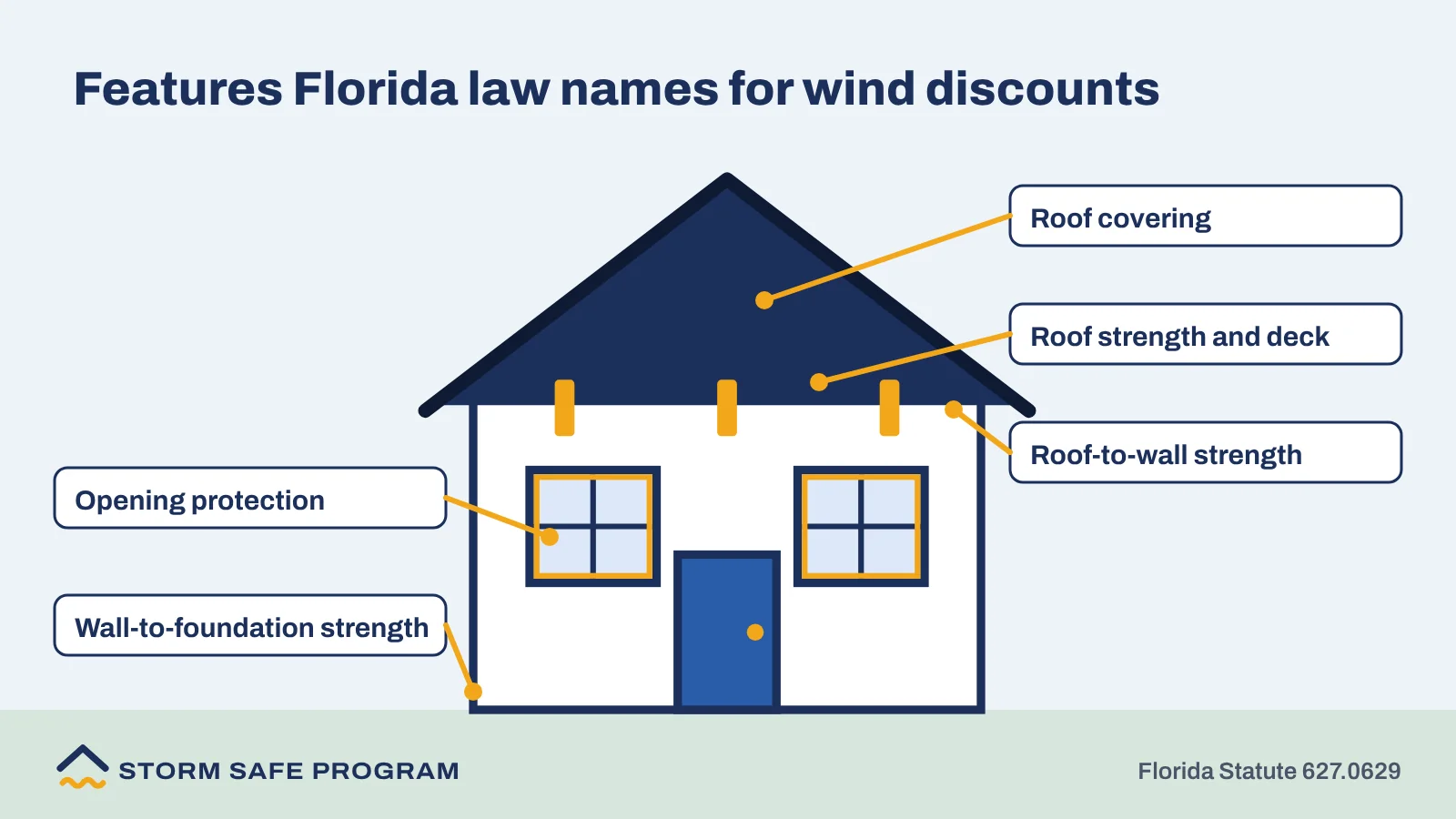
The law lists features that enhance:
- Wind uplift prevention
- Roof strength
- Roof covering performance
- Roof-to-wall strength
- Wall-to-floor-to-foundation strength
- Opening protection
- Window, door and skylight strength
The statute says the list isn't limited to these, but these are the big ones.
How do you actually get the discount?
Your insurer won't take your word for it. You need a wind mitigation inspection on Florida's Uniform Mitigation Verification Inspection Form, OIR-B1-1802. The Office of Insurance Regulation updated the form, and the new version (Rev. 04/26) took effect April 1, 2026.
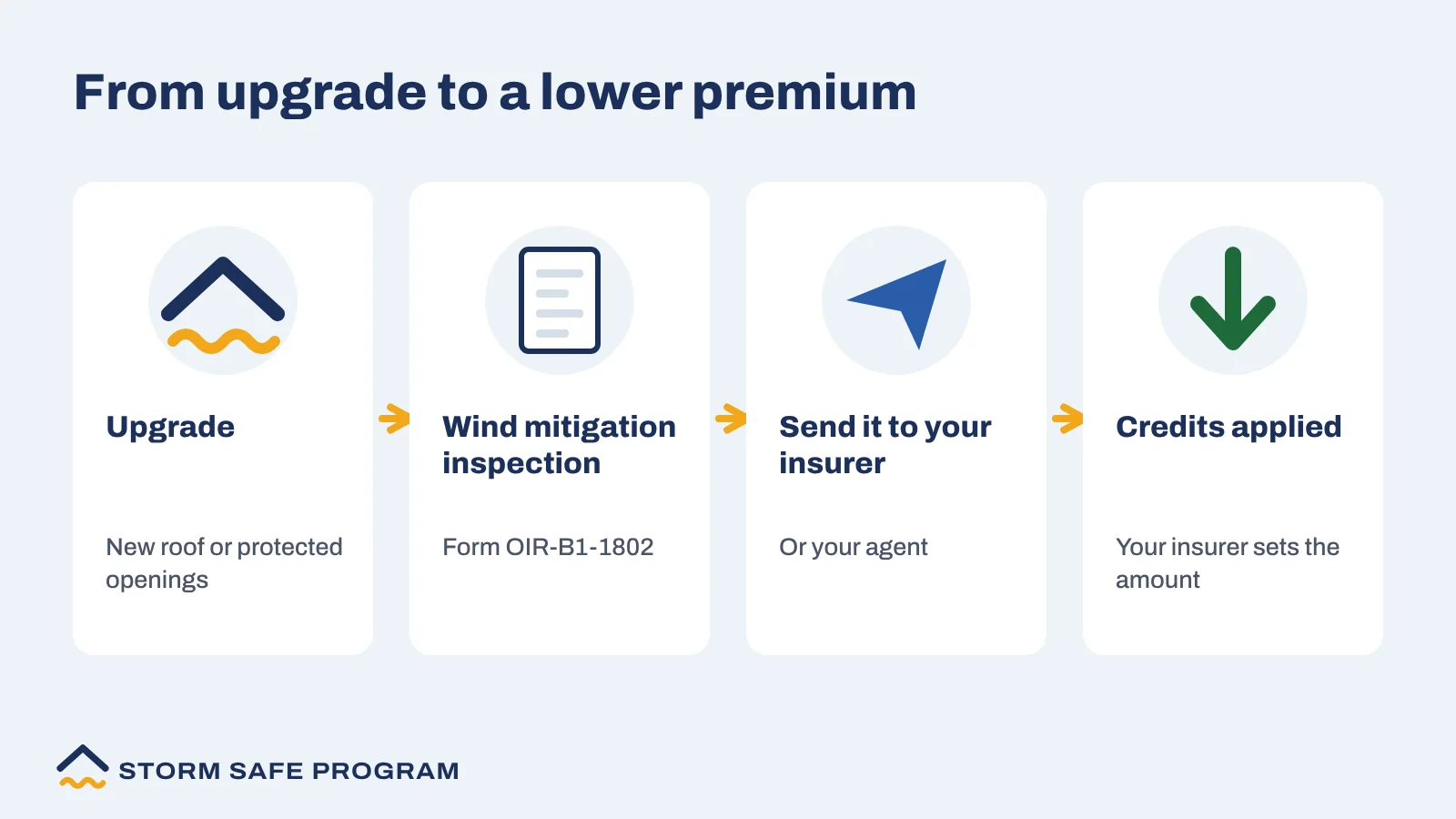
A few rules from Citizens Property Insurance, Florida's state backed insurer, show how this works in practice:
- The form has to be signed by a qualified inspector, like a home inspector, contractor or engineer, and by the homeowner.
- Citizens won't give mitigation credits if an unqualified or unlicensed inspector fills out the form.
- A form generally stays good for 5 years, as long as nothing about the structure has changed.
- Citizens says the 2026 form changes didn't change the credits it offers.
Want the full picture of what the inspector looks at? Read What is a wind mitigation inspection?
Which upgrades make the biggest difference?
Citizens' wind loss mitigation guide shows how each part of the form gets credited. A few highlights:
- Roof covering: a roof that meets the Florida Building Code, with permit or product approval and the install year, can get credit.
- Roof deck attachment: how the plywood is nailed to the frame. The weakest attachment found is what counts.
- Roof-to-wall attachment: clips, single wraps and double wraps each have their own level. Again, the weakest one counts.
- Roof shape: hip roofs earn a mitigation discount.
- Secondary water resistance: a sealed roof deck gets credit.
- Opening protection: credit is based on the weakest protected opening, so one unprotected window can hold you back.
A new roof is often the biggest single step. If you're comparing roof types, PITCH Roofing's guide to the best roof for hurricanes breaks it down, and their piece on how your roof could save you from the homeowners insurance crisis covers the insurance side. PITCH also includes a free wind mitigation inspection with select new roof packages.
What about my roof's age?
That's a different law. Under Florida Statute 627.7011, an insurer can't refuse to write or renew your homeowners policy just because of roof age if the roof is less than 15 years old.
If your roof is 15 or older, the insurer has to let you get a roof inspection by an authorized inspector, at your cost, before it requires a replacement. And if that inspection shows at least 5 years of useful life left, the insurer can't refuse you based on roof age alone. PITCH Roofing explains this further in can insurance make you replace a roof?
How Storm Safe Program can help
If your roof is more than 10 years old, or your windows or doors aren't impact rated, and you live in Hillsborough or Pinellas County, your home may qualify to have them replaced, with no upfront costs in most cases. Those are the same features this law rewards. We handle the permits, the installation and the city inspections. See the upgrades we cover.
Common questions
Does 627.0629 guarantee a certain discount?
No. The law requires insurers to include actuarially reasonable discounts or credits, but each insurer sets its own amounts. Ask your agent what applies to your policy.
Do I need a new wind mitigation inspection after I replace my roof?
Usually, yes. A wind mitigation form only reflects the home as it was on inspection day. If you've made upgrades since then, a new inspection is how your insurer learns about them.
Who can sign the wind mitigation form?
A qualified, licensed inspector such as a home inspector, contractor or engineer, plus the homeowner. Citizens won't give credits for a form completed by an unqualified or unlicensed inspector.
Can my insurer drop me because my roof is old?
Not just for age if the roof is under 15 years old. For older roofs, you can get an inspection first, and if it shows 5 or more years of useful life left, the insurer can't refuse you for roof age alone.
Make your home stronger, with no upfront costs in most cases
Call or text "Safety" to (727) 687-3364, or see if your home qualifies.
Sources
- Florida Statute 627.0629, Residential property insurance; rate filings
- Florida Statute 627.7011, Homeowners' policies; offer of replacement cost coverage and law and ordinance coverage
- Citizens Property Insurance: Uniform Mitigation Verification Inspection Form changes
- Citizens Property Insurance: Wind Loss Mitigation Guide (Rev. 04/26)
- PITCH Roofing: Best roof for hurricanes
- PITCH Roofing: Can insurance make you replace a roof?